Industriearmaturen 3 Way Ball Valves

3-Way Ball Valve in Stainless Steel and Brass – L-Port and T-Port

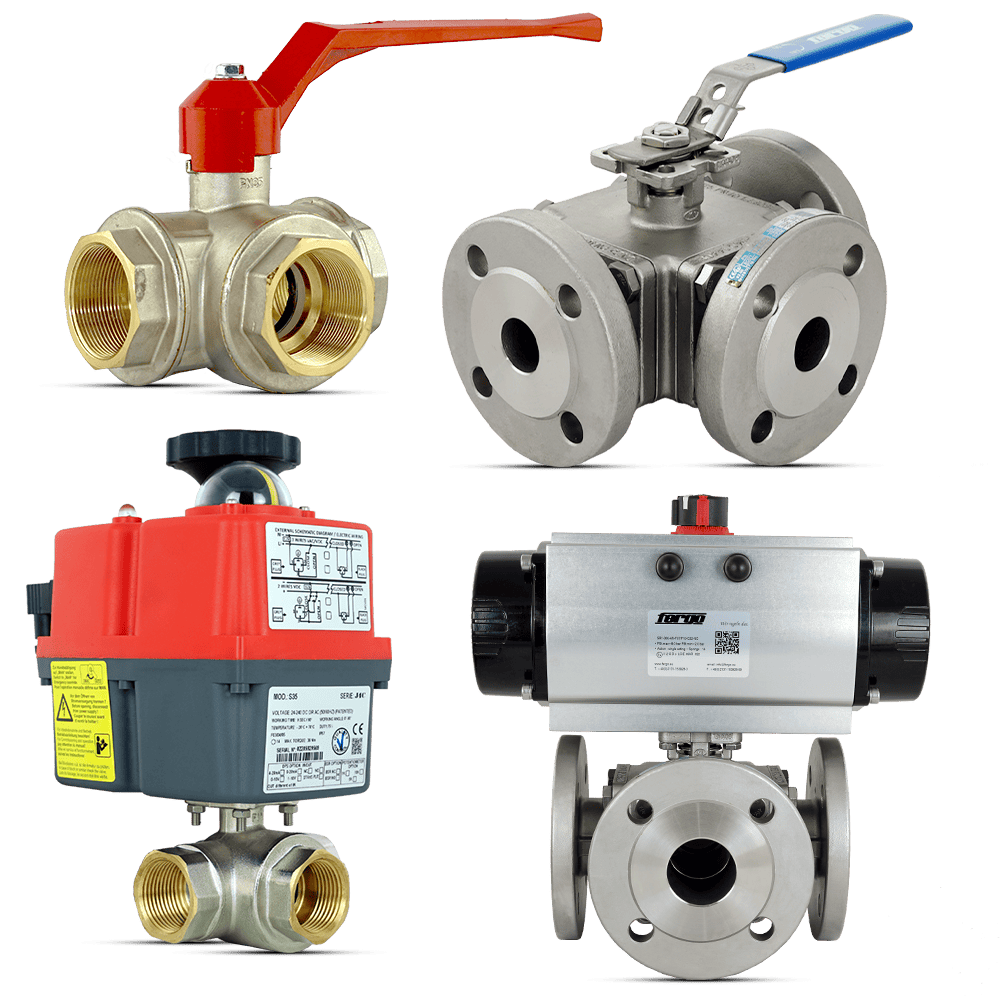
Fergo supplies 3-way ball valves from the KL103 series in stainless steel 1.4408 and KL113 series in brass CW617N. DN15 to DN50, PN25/63, with L-port or T-port bore, PTFE seat, manual, pneumatic or electric actuation via ISO 5211.

Buy now in the shop →

3 Way Ball Valves
Product Overview

3-Way Ball Valves – DN15 to DN50, PN25 to PN63, Stainless Steel and Brass

The 3-way ball valve uses a ball with an L-port or T-port bore that diverts, mixes or distributes the media flow between three connections with a 90° quarter-turn. The L-port configuration switches flow between two outlets while blocking the third. The T-port configuration enables simultaneous mixing or distribution to both outlets. This quarter-turn mechanism consequently provides fast and reliable media control. 3-way ball valves in steel comply with EN 17292 for industrial ball valves.

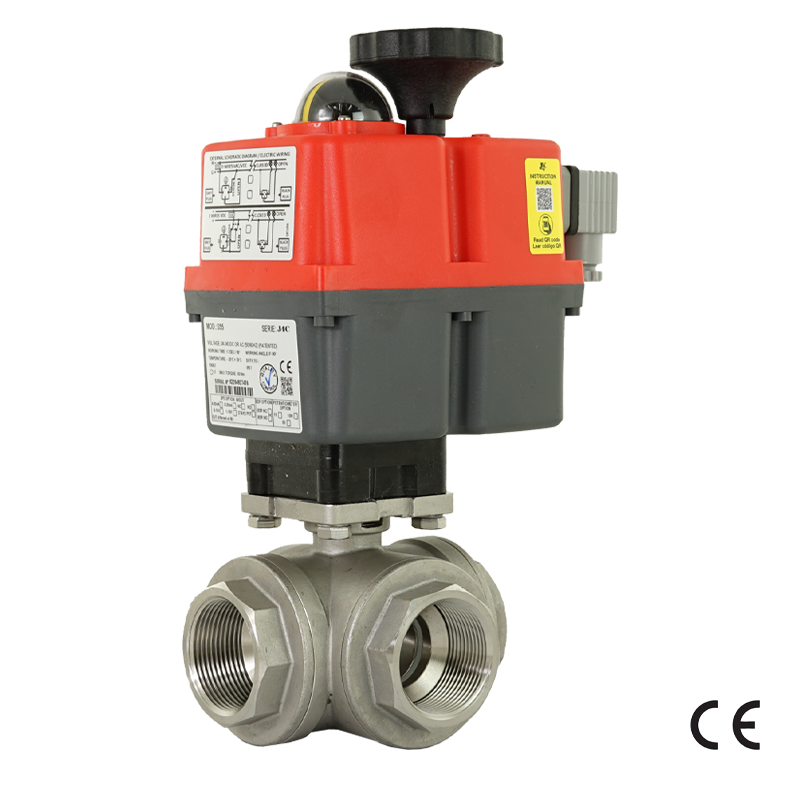
Fergo offers two series of 3-way ball valves. The KL103 series is manufactured from stainless steel 1.4408 (CF8M / AISI 316) with threaded female connection per ISO 7-1 (EN 10226-1), DN15 to DN50, PN63. The seat is PTFE+15% glass fibre for improved wear resistance. The KL113 series is manufactured from brass CW617N with BSP threaded female connection per ISO 228-1, DN15 to DN50, PN25. The seat is PTFE. Both series are available in 3-piece construction with L-port or T-port bore. Operation is via manual lever, pneumatic quarter-turn actuator (DA/SR) or J4C electric actuator via the standardised ISO 5211 mounting interface.

These 3-way ball valves are designed for HVAC systems, chemical industry, food processing, pharmaceuticals, water treatment, dosing systems and mixing circuits. For applications requiring larger nominal diameters or flanged connections, the flanged ball valves of the KH155 series provide an alternative. A Y-strainer upstream of the ball valve is furthermore recommended to protect the ball against particles.

01 3-Way Ball Valve in Stainless Steel – KL103 Series

The 3-way ball valves in stainless steel of the KL103 series use a body, ball and stem in stainless steel 1.4408 (CF8M / AISI 316). The threaded connection conforms to ISO 7-1 (EN 10226-1). Nominal diameters range from DN15 to DN50 at a pressure rating of PN63. The seat is PTFE+15% glass fibre for improved wear resistance and reduced cold flow. The L-port enables flow switching between two outlets, while the T-port enables mixing or distribution. This series is consequently suited for chemical processing, food and beverage, pharmaceuticals and corrosive media.

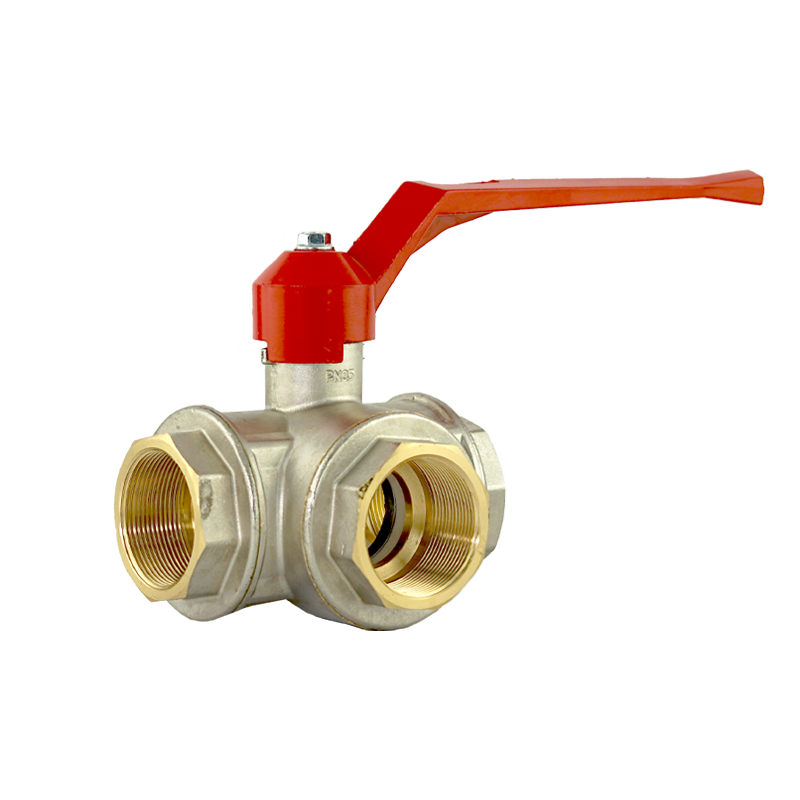
02 3-Way Ball Valve in Brass – KL113 Series

The 3-way ball valves in brass of the KL113 series use a body in brass CW617N with BSP threaded female connection per ISO 228-1. Nominal diameters range from DN15 to DN50 at a pressure rating of PN25. The seat is PTFE. This series consequently provides an optimal cost-performance ratio for HVAC mixing circuits, heating systems, sanitary installations and cold water circuits where corrosive exposure is not present.

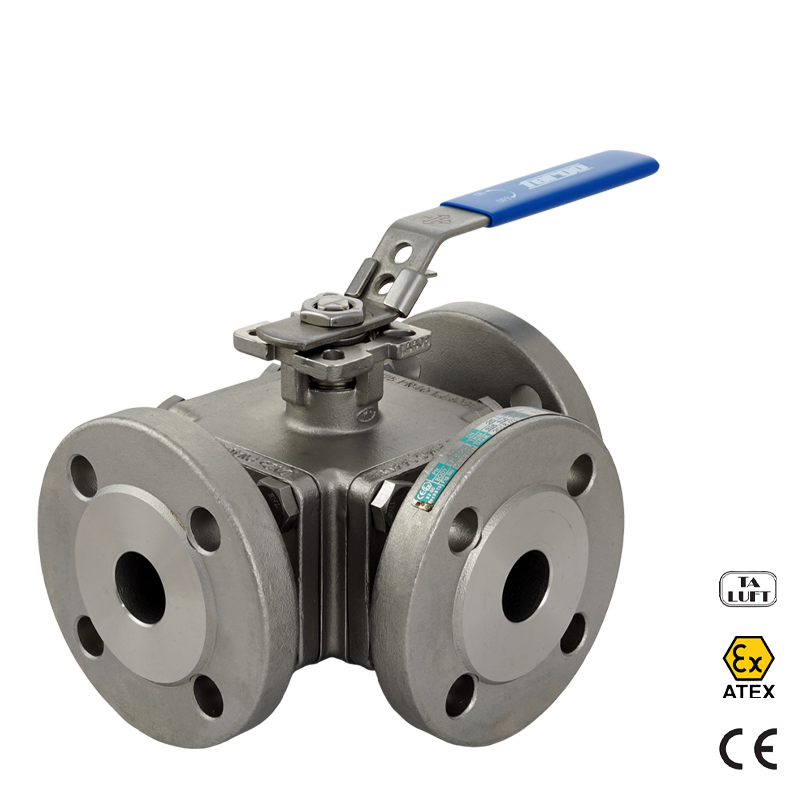
03 3-Way Flanged Ball Valve – T-Port and L-Port

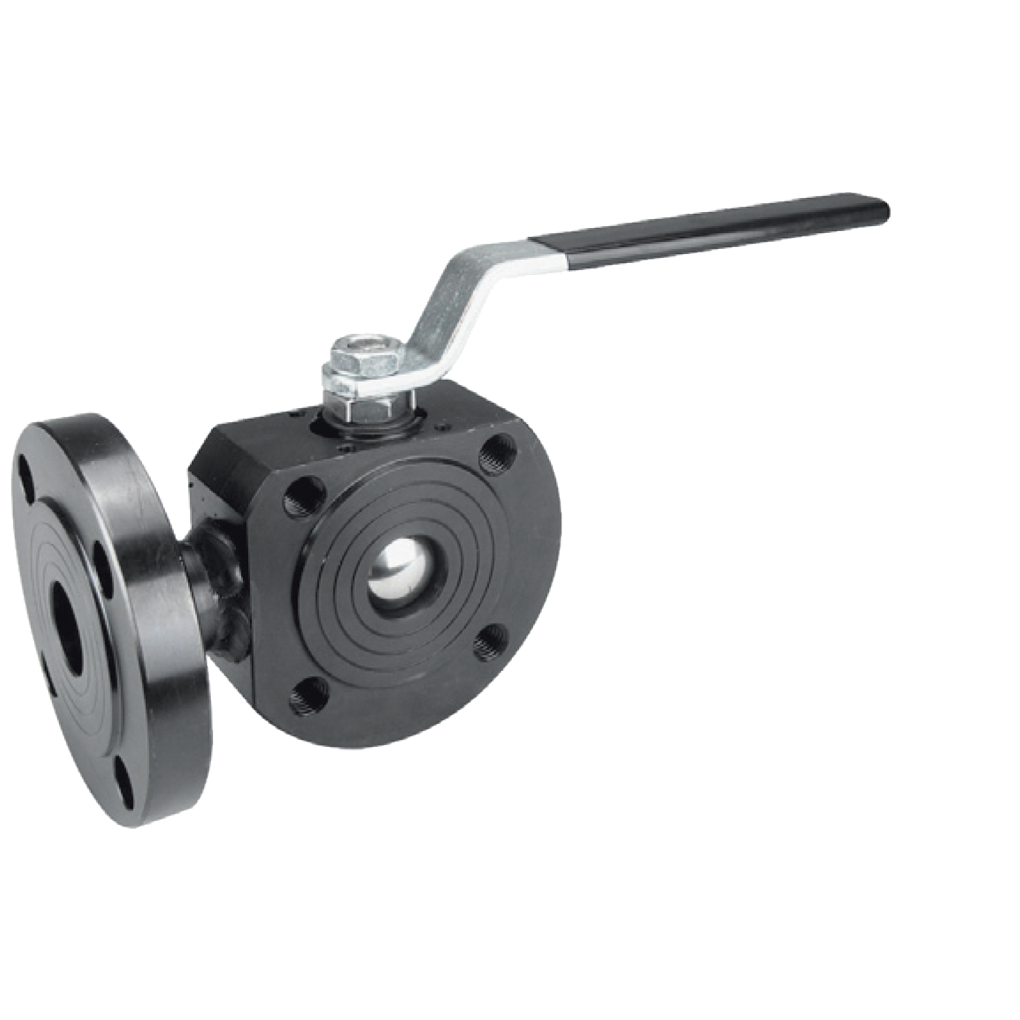
The 3-way flanged ball valve offers the same L-port or T-port bore as the threaded versions, but with a standardised flanged connection per EN 1092-1/EN 1092-2. This configuration consequently enables installation in pipelines with larger nominal diameters and higher pressure ratings where a threaded connection is not sufficient. The flanged connection furthermore simplifies removal for maintenance purposes. The ISO 5211 mounting interface allows the attachment of pneumatic and electric quarter-turn actuators.

04 3-Way Compact Ball Valve

The 3-way compact ball valve is the space-saving variant with threaded female connection for installation in confined spaces. The reduced face-to-face length and low weight make this version consequently the first choice for HVAC mixing circuits, dosing systems and decentralised installations. The KL103 series (stainless steel 1.4408, PN63) and KL113 series (brass CW617N, PN25) are available in this compact design with L-port or T-port bore from DN15 to DN50.

05 AMP3 – 3-Way PFA-Lined Ball Valve (Flowserve Atomac)

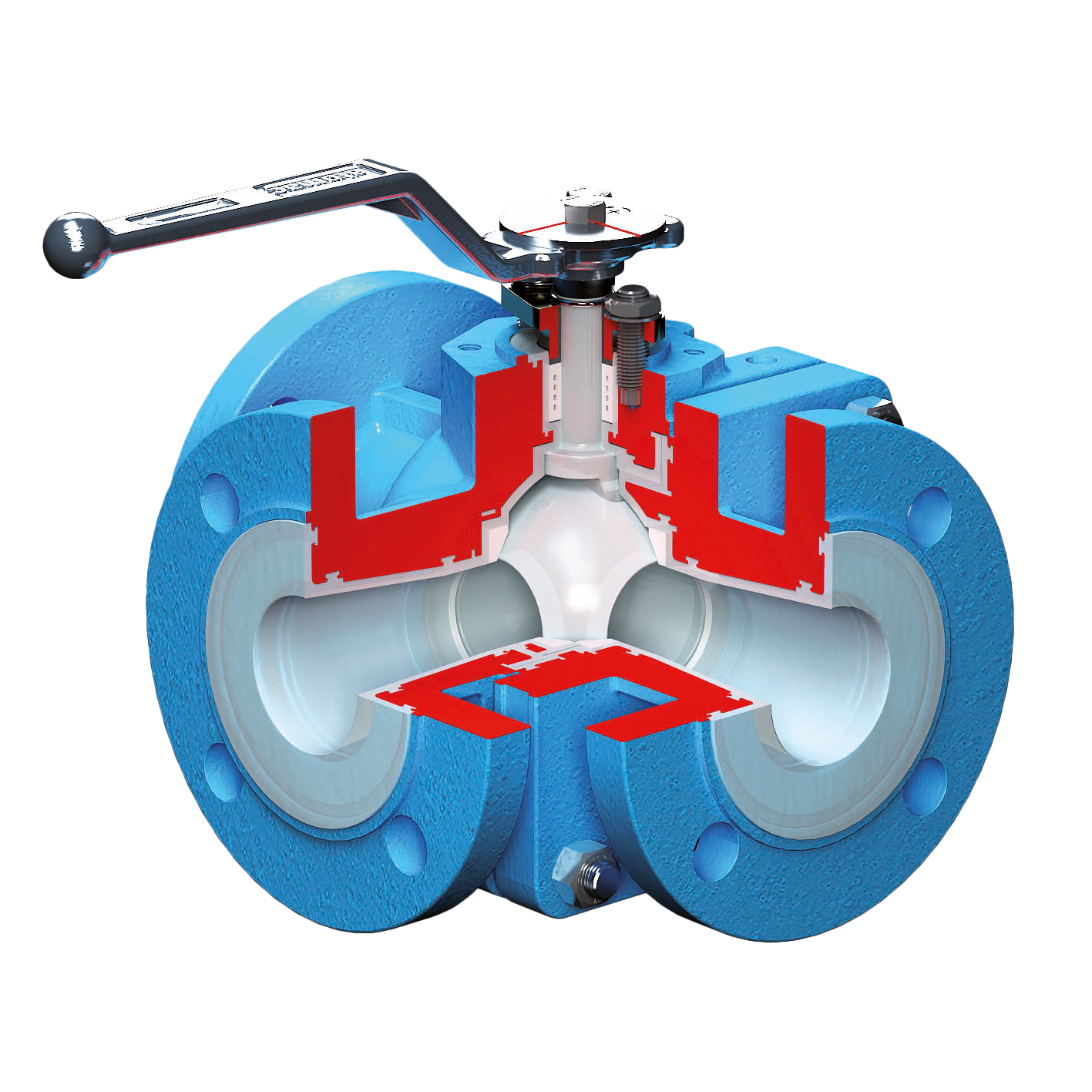
The AMP3 3-way ball valve from Flowserve Atomac features a GGG40.3 body with full PFA lining. The ball with L-port or T-port bore is also PFA-lined. Nominal diameters range from DN25 to DN100. The seat rings are PTFE for bubble-tight shut-off. This version consequently provides near-total chemical resistance and is the solution for concentrated acids, strong bases, solvents and high-purity media in the chemical and pharmaceutical industry. The PFA valve overview in the shop contains all available variants.

Materials of the 3-Way Ball Valves – Body, Ball and Seat

1. Stainless Steel 1.4408 (CF8M / AISI 316)

Application: chemical industry, food processing, pharmaceuticals, water treatment and corrosive media.
Temperature: –25 °C to +180 °C (with PTFE+15%GF seat).
Advantages: corrosion resistance in acidic, alkaline and saline media. Body, ball and stem in CF8M ensure high media purity. The PN63 pressure rating consequently covers high-pressure applications.
Limitations: higher unit cost than brass. For neutral media at moderate temperatures, the KL113 brass series provides a more economical alternative.

2. Brass CW617N

Application: heating, sanitary, HVAC mixing circuits, cold water and compressed air from DN15 to DN50.
Temperature: –15 °C to +150 °C.
Advantages: good corrosion resistance in neutral media, BSP threaded connection for quick installation and low weight. The PN25 pressure rating consequently covers standard building installations.
Limitations: not suited for strongly acidic media, solvents or high-temperature applications above 150 °C.

3. L-Port – Flow Diversion

Application: switching the media flow between two outlets while blocking the third connection.
Advantages: a 90° turn diverts flow from one outlet to the other. This configuration is consequently ideal for changeover duty, bypass circuits and sampling.
Limitations: simultaneous mixing or distribution to both outlets is not possible with L-port.

4. T-Port – Mixing and Distribution

Application: mixing two media streams or distributing one stream to two outlets.
Advantages: the T-port allows flow to one, both or neither outlet depending on ball position. This configuration is consequently ideal for mixing circuits, temperature control and dosing systems.
Limitations: complete simultaneous shut-off of all three connections is not possible by design.

5. Seat PTFE / PTFE+15% Glass Fibre

Application: ball seat for all KL103 and KL113 versions.
Temperature: PTFE –15 °C to +150 °C; PTFE+15%GF –25 °C to +180 °C.
Advantages: near-total chemical inertness and low friction coefficient. The glass fibre reinforcement furthermore reduces cold flow under static load.
Limitations: PTFE is a wear component. Periodic inspection is recommended depending on cycle count and media type.

6. Actuation Interface ISO 5211

Application: all KL103 and KL113 versions with standardised mounting flange for manual levers, pneumatic and electric actuators.
Advantages: the ISO 5211 interface enables direct mounting of DA/SR pneumatic actuators and J4C electric actuators. Retrofitting an actuator is consequently possible at any time without body modification.
Limitations: actuator selection depends on the required torque and nominal diameter.

The choice between L-port and T-port determines the flow paths of the 3-way ball valve in each switching position. The correct selection consequently depends on the required flow scheme of the installation. Both bore types use the same body and the same ball — only the bore geometry differs.

L-Port – Flow Diversion Between Two Outlets

With the L-port bore, the ball connects exactly two of the three connections in each 90° position while blocking the third. In the starting position (0°), the medium flows from the inlet to the left outlet. After a 90° turn, the medium flows from the inlet to the right outlet. The L-port is consequently suited for changeover duty, where the media stream is switched between two consumers, two process lines or a main line and a bypass. Typical applications include switching between heat exchangers, sampling from a main pipeline and diverting flow during maintenance of downstream equipment. Simultaneous supply to both outlets is not possible by design.

T-Port – Mixing, Distribution and Shut-Off

With the T-port bore, the ball can connect two or all three connections simultaneously depending on the rotational position. In the starting position (0°), the medium flows from the inlet to both outlets at the same time (distribution). After a 90° turn, the medium flows only to the right outlet. After a further 90° turn (180°), the T-port connects the two outlets to each other while blocking the inlet. The T-port is consequently suited for mixing circuits, where two media streams of different temperature or concentration are combined. Typical applications include supply and return mixing in HVAC systems, temperature control in cooling circuits, chemical dosing in process pipelines and distribution of a single media stream to two parallel consumers. Furthermore, the T-port enables stepless flow mixing in an intermediate position when the ball valve is operated with a positioner.

Selection Guide — When L, When T?

The L-port is the right choice when the media stream should take only one of two paths at any given time — that is, for pure changeover duty without mixing. The T-port is the right choice when two streams need to be mixed, one stream needs to be distributed, or a circuit requires partial recirculation. For applications requiring complete simultaneous shut-off of all three connections, a separate 2-way shut-off valve in the main line is additionally recommended. If there is any uncertainty regarding the bore selection, the Fergo technical team is happy to assist with the sizing.

Fergo 3-way ball valves comply with the key European standards for industrial valve engineering. The stainless steel versions meet EN 17292 for industrial ball valves. Thread connections conform to ISO 7-1 (EN 10226-1) for stainless steel and ISO 228-1 for brass. The European Pressure Equipment Directive 2014/68/EU (PED) is covered for the applicable models.

Factory certificates and declarations of conformity are available on the Fergo certificates page. To verify the compatibility of the body or seat material with a specific medium, the chemical resistance check tool provides a fast and reliable selection.

Fergo offers a comprehensive range of 3-way ball valves available from stock in Neuss, Germany. Shipping covers the UK, Ireland, the Nordics and the rest of the EU. Standard delivery via DHL is 2–7 working days. An express shipping option is also available. All terms are detailed on the shipping and payment terms page.

For projects requiring a pre-assembled unit with pneumatic or electric actuator, a special bore configuration or a custom nominal diameter, Fergo develops customised solutions. The technical team supports every enquiry from specification to delivery.