
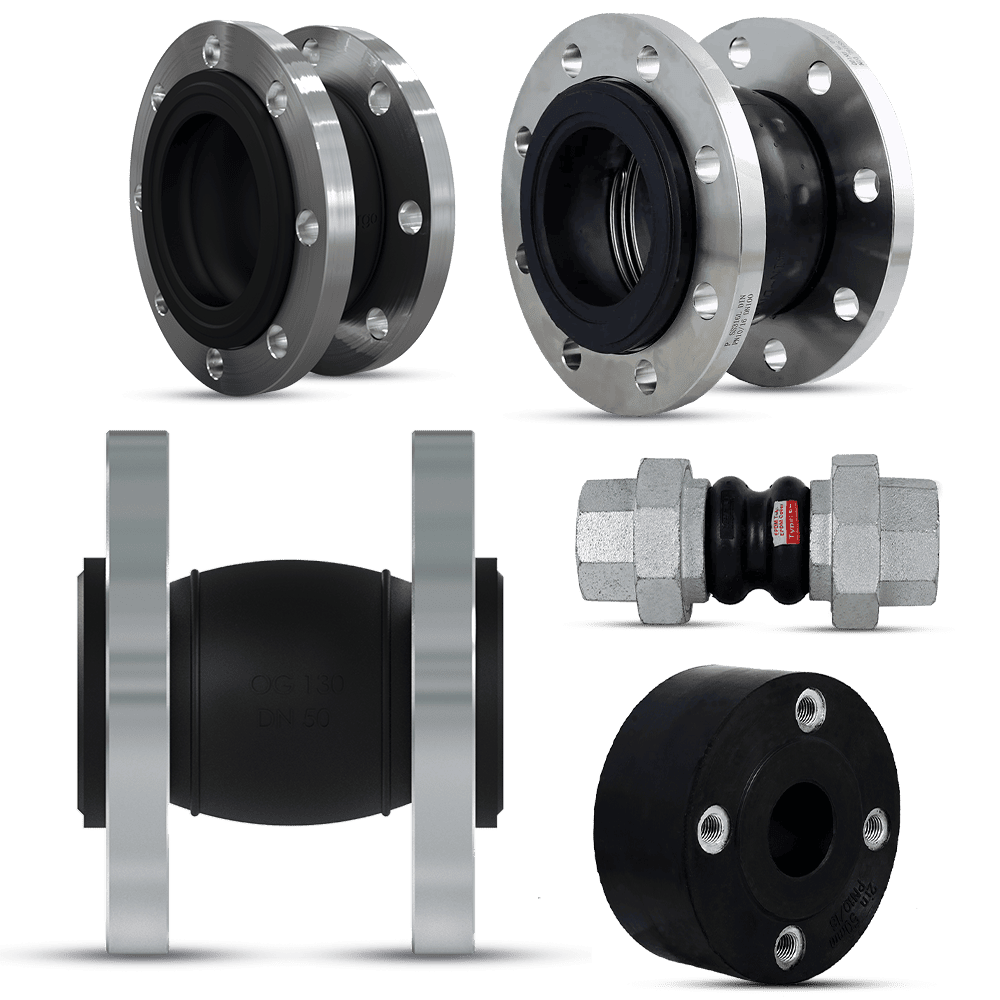
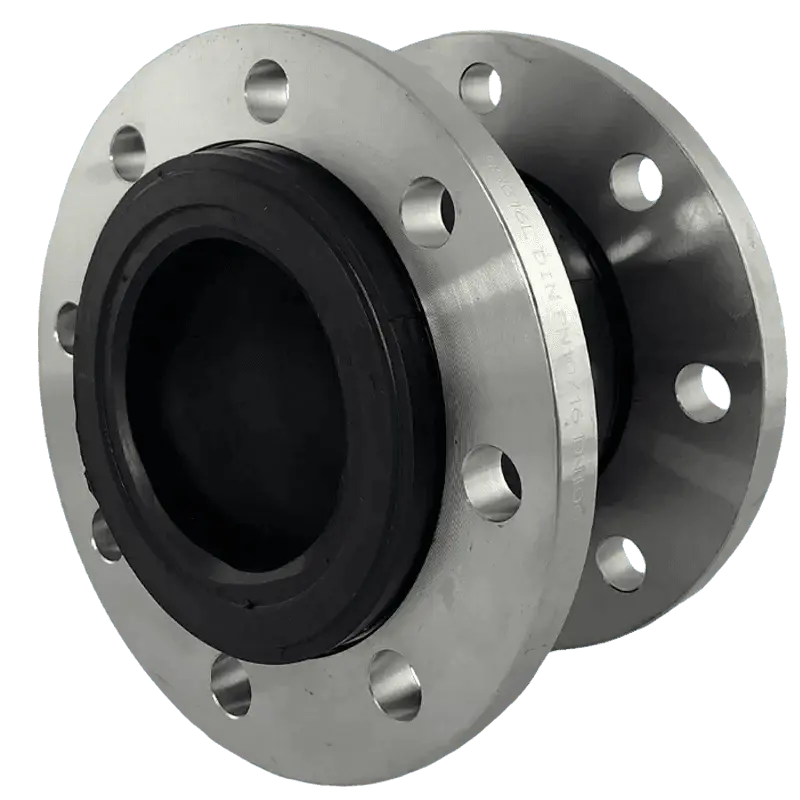
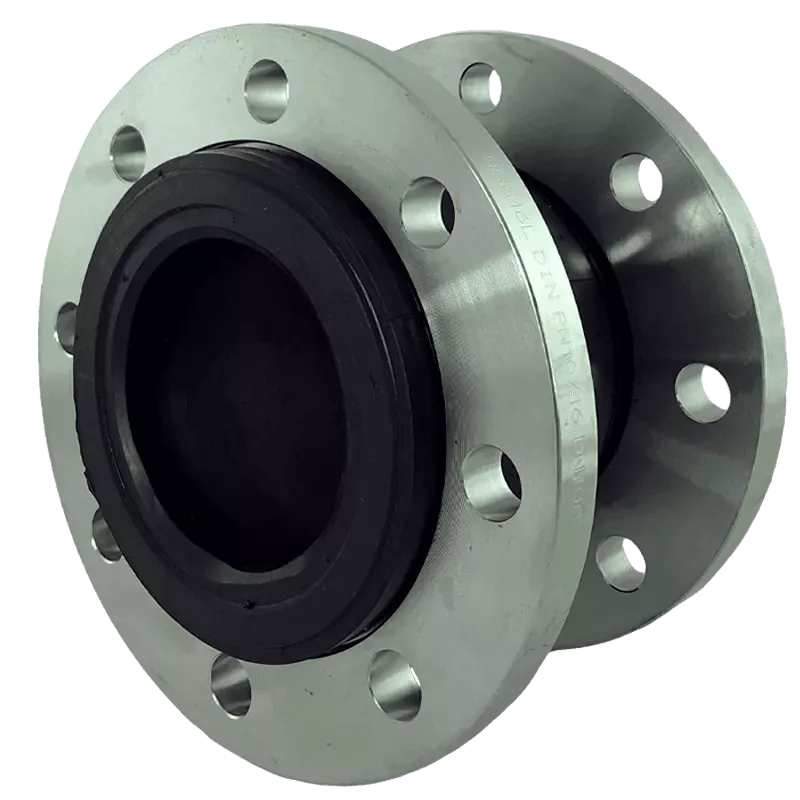
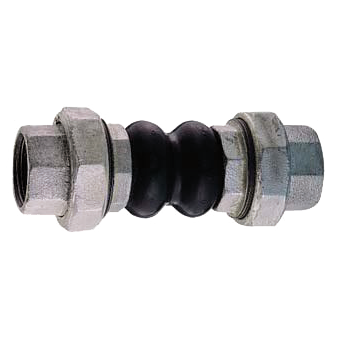
Materials of the Expansion Joints – Bellows and Flanges
1. Bellows EPDM (Ethylene-Propylene-Diene Rubber)
Application: drinking water (DVGW-capable), cold and hot water, HVAC, heating systems, condensate, diluted acids and alkalis, glycol-based brake fluids, ozone-loaded environments.
Temperature: –30 °C to +110 °C.
Colour code: red.
Advantages: excellent ozone, UV, weathering and ageing resistance, higher temperature capability than NBR, drinking-water approved.
Limitations: not suited for mineral oils, greases, fuels and aromatic hydrocarbons.
2. Bellows NBR (Nitrile-Butadiene Rubber)
Application: mineral oils, hydraulic oils, fuels (diesel, petrol), greases, heating oil, biogas, natural gas, oil-laden media and compressed air with oil content.
Temperature: –20 °C to +90 °C.
Colour code: yellow.
Advantages: excellent resistance to aliphatic hydrocarbons, oils and fuels.
Limitations: not resistant to ozone, UV, aromatic hydrocarbons and strongly oxidising media.
3. Bellows Reinforcement – Nylon Cord
Construction: multi-layer nylon cord inlay in the elastomer bellows, fabric-reinforced for pressure resistance and dimensional stability.
Advantages: absorbs the axial tensile and compressive forces without impairing the elasticity of the elastomer, prevents bulging under internal pressure, secures the PN10/PN16 pressure rating.
4. Galvanised Steel Flanges
Application: standard for HVAC, drinking water, wastewater, cooling water, heating systems.
Material: S235JR (1.0038) with electroplated or hot-dip galvanising.
Advantages: cost-effective, sufficient corrosion resistance in normal operating environments, high flange rigidity.
Limitations: not suited for aggressive chemicals, seawater and applications with frequent moisture exposure without additional corrosion protection.
5. Stainless Steel Flanges SS316 (1.4408 / 1.4404)
Application: chemical processing, pharmaceuticals, food and beverage, seawater, drinking water (recommended per DIN 4809), aggressive process media.
Advantages: full corrosion resistance, hygienically safe, significantly longer service life than galvanised steel in aggressive media.
Limitations: higher unit cost.
6. Galvanised Ductile Iron Flanges (EN-GJS-400-15)
Application: OG111 series (threaded rubber expansion joint) with BSPP female thread.
Advantages: high mechanical strength, good thread machinability, compact form.
Limitations: limited nominal sizes (only OG111 series, 1 inch to 3 inch).
7. Vacuum Support Ring – Stainless Steel SS316
Construction: ring-shaped reinforcement in stainless steel SS316 inside the bellows to prevent collapse under sub-atmospheric pressure.
Advantages: enables rubber expansion joint use in vacuum and suction lines.
Limitations: reduces movement absorption by approx. 50 %.