
Industriearmaturen Ball Check Valves

Ball Check Valves in Stainless Steel & GGG40 — Ex Stock

Ball check valves DN15–DN500 for wastewater, pumps & solids-laden media. GGG40, stainless steel & PFA-lined. PN10/PN16. Order online!

Buy now in the shop →

Ball Check Valves
INTRODUCTION

Ball Check Valves for Wastewater and Process Lines

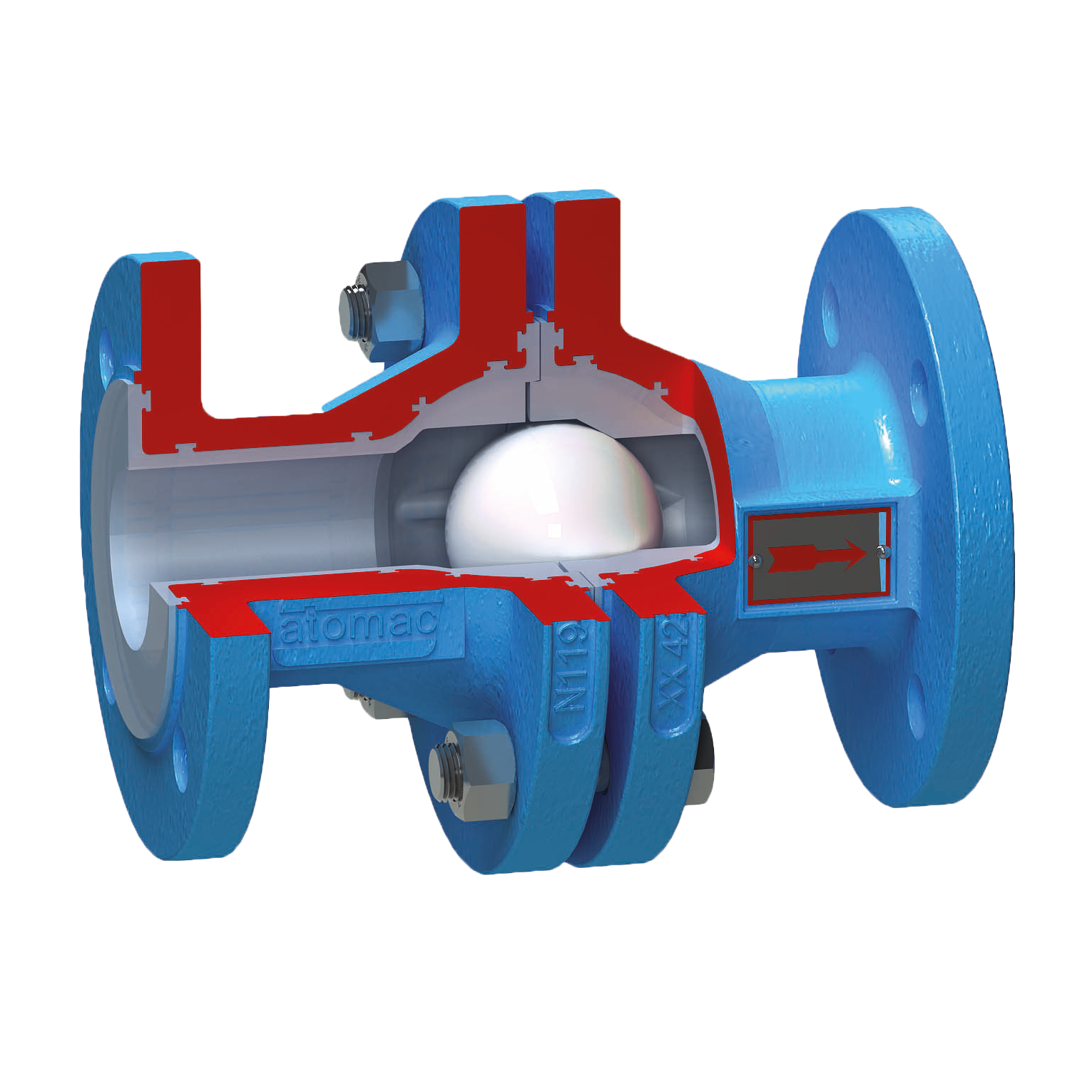
A jammed check valve in the discharge line of a sewage pump shuts down the pumping station — and the failure is rarely the valve itself, it is the wrong valve type. Swing check valves and spring-loaded designs work reliably in clean media but clog in fibrous and solids-bearing flow. The ball check valve, also known as a ball non-return valve, solves exactly this problem through a different closing action.

FERGO supplies ball check valves in ductile iron, stainless steel and PFA-lined versions, with flanged or threaded connections and NBR, PTFE or FKM seals. This page covers the operating principle, the available series and the selection criteria against other non-return valve types.

01 Selecting Seal Material and Temperature Range

The standard temperature range is –20 °C to +80 °C. The ball coating and the seal material determine which media are permissible:

  • NBR — standard. Resistant to wastewater, mineral oils and greases, –20 °C to +80 °C.
  • PTFE — for acids, alkalis and high-purity media, the broadest chemical resistance.
  • FKM/Viton — for solvents, fuels and petrochemical media.
  • PFA lining — complete media separation, temperature range up to +200 °C.

NBR is not resistant to solvents and strong acids. Where the media composition is unclear, FERGO technical support reviews the material combination before ordering.

Body Materials

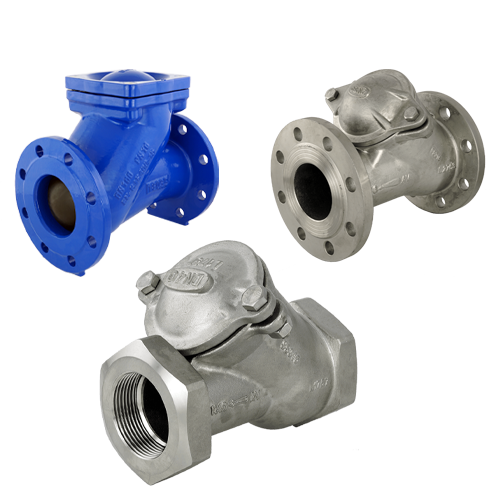
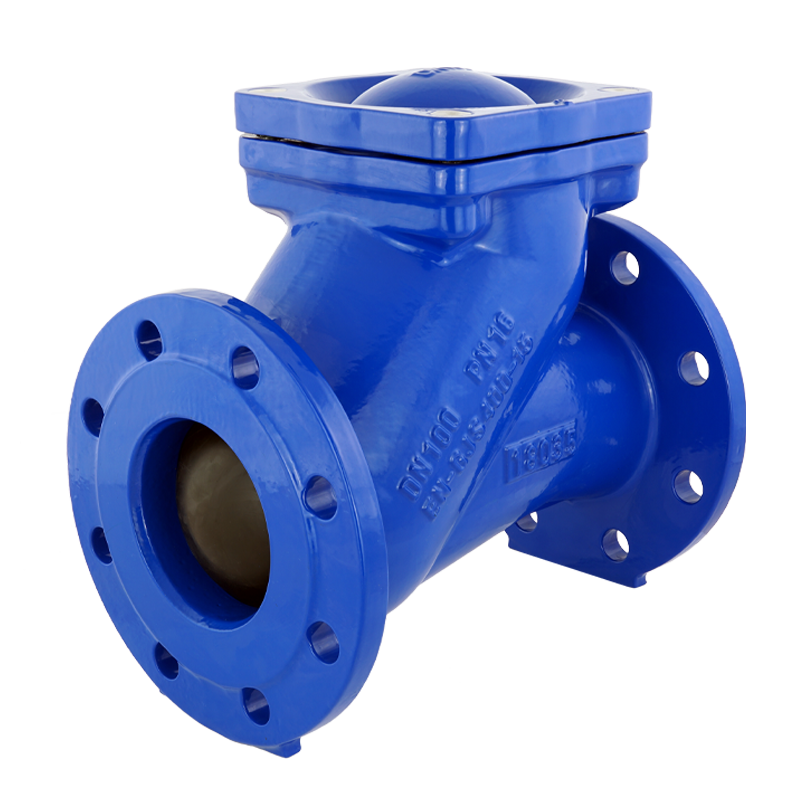
1. Ductile Cast Iron GGG40 / EN-GJS-400-15 (RB105)

  • Application: wastewater, sewage plants, water supply, irrigation, cooling water circuits, industrial utility service
  • Temperature: −20 °C to +80 °C · PN10 and PN16
  • Advantages: high toughness, good vibration damping, economical for larger bores up to DN500, standard epoxy coating for corrosion protection
  • Limitations: unsuitable for aggressive chemicals, chloride-loaded brines or steam

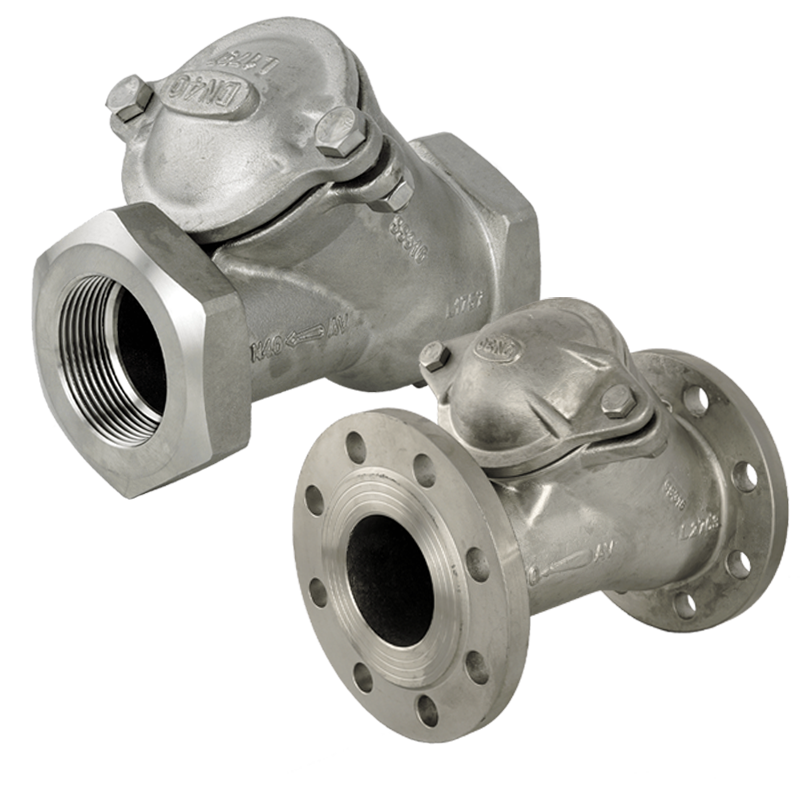
2. Stainless Steel 1.4408 / CF8M (AISI 316) (RB106)

  • Application: chemical and pharmaceutical processing, food and beverage plants, seawater, potable water, hygiene-critical service
  • Temperature: −20 °C to +80 °C standard; higher on request with PTFE or Viton seats
  • Advantages: high corrosion resistance through molybdenum, hygienic surface, all wetted parts in 1.4408, no iron contamination of the medium
  • Limitations: higher material cost than GGG40; longer lead time on larger sizes

3. Ductile Iron GGG40.3 with PFA Lining (special design)

  • Application: concentrated acids, alkalis, halogens and dosing lines where metal contact must be avoided
  • Temperature: −20 °C to +200 °C
  • Advantages: near-universal chemical resistance, mechanical stability of the ductile iron body, complements the PFA-lined check valves range
  • Limitations: special order with surcharge; lining sensitive to abrasive solids

Ball and Coating Materials

1. Aluminium Ball NBR-Coated (RB105)

  • Application: wastewater, water supply, irrigation, cooling water — the standard ball of the GGG40 flanged series
  • Temperature: −20 °C to +80 °C
  • Advantages: lightweight ball rolls easily onto the seat, NBR coating dampens closure and reduces water hammer, abrasion-resistant against grit and fibres
  • Limitations: NBR is not ozone-resistant; unsuitable for oxidising chemicals

2. Steel Ball NBR-Coated (RB106)

  • Application: stainless steel series with BSP socket or DIN flange — chemical, food, pharma and hygienic water applications
  • Temperature: −20 °C to +80 °C
  • Advantages: high mass gives reliable closure at low back pressure, NBR coating ensures a tight metal-to-elastomer seal
  • Limitations: NBR limits the maximum operating temperature; not compatible with polar solvents and strong acids

3. PTFE Seat / Coating (on request)

  • Application: aggressive acids, alkalis, solvents and oxidising agents where NBR fails
  • Temperature: up to +150 °C
  • Advantages: near-universal chemical resistance, very low friction, FDA-compliant for food and pharmaceutical service
  • Limitations: higher price than NBR; needs precise seat pairing for a fully tight closure

4. FKM / Viton Seat / Coating (on request)

  • Application: hydrocarbons, mineral oils, aromatic solvents and elevated temperatures beyond the NBR window
  • Temperature: up to +180 °C
  • Advantages: high chemical and thermal resistance, ozone-resistant, long service life in petrochemical and oil-and-gas duty
  • Limitations: unsuitable for ketones, esters, hot water and steam

Ball Check Valve or Swing Check Valve?

The deciding factor is the solids load of the medium. In clean water, air and neutral media the wafer check valve is the more compact and economical choice. As soon as fibres, sand or sludge are present, the disc and hinge jam — and the ball check valve is the correct design.

Criterion Ball check valve Wafer check valve Disco check valve
Closing mechanism Free-moving ball, gravity Hinged disc, partly spring-assisted Spring-loaded cone
Solids tolerance High — including fibres and sludge Low Very low
Face-to-face length Long (EN 558-1 series 48) Very short Short
Pressure drop Low, full bore Medium Higher due to spring force
Wear parts The ball only Hinge, seat ring, spring Spring, guide, seat
Typical application Wastewater, sludge, pump discharge Water, air, HVAC Steam, process lines

The full programme is listed under check valves; for clean media with limited installation space, the wafer check valve is the better fit.

Ball check valves are installed horizontally or vertically with upward flow. The ball must be able to roll back into the seat under its own weight — which is not the case with downward flow. The flow direction is marked on the body.

Flange connections conform to DIN EN 1092-2 in PN10 and PN16, threaded connections to EN ISO 228-1. ANSI Class 150 is available on request. A straight settling section downstream of the pump reduces ball chatter under strongly pulsating delivery.

All series comply with the Pressure Equipment Directive 2014/68/EU and carry CE marking. Test certificates to EN 10204 are available in types 2.1, 2.2 and 3.1 and should be ordered together with project quantities.

Common nominal sizes are available from stock and ship from one working day across the EU. For non-standard material combinations, special coatings or project quantities, FERGO builds custom solutions to your operating data.