Industriearmaturen Check Valves

Check Valves in Stainless Steel, GGG40 & Brass — Buy Online

Wafer, dual plate and threaded check valves, stainless steel
1.4408, ductile iron, brass or PP-H, DN10 to DN400, PN6 to PN40, with or without
spring return.

Buy now in the shop →

Check Valves
Product Overview

Check Valves: Automatic Backflow Protection for Pipelines

check valve — also known as a non-return valve — works on differential pressure alone. Forward flow lifts the disc off its seat, so the medium passes freely. As soon as the flow stops or reverses, the disc drops back onto the seat. It therefore needs no actuator, no control signal and no external energy.

Fergo supplies check valves in the RK and RF series from DN10 to DN400. Pressure ratings run from PN6 to PN40, and ANSI Class 125 to Class 300 covers inch-based pipework. Wafer bodies fit between flanges to EN 1092-1 form B and DIN 2632/2633, while dual plate face-to-face lengths follow EN 558-1 series 16. Bodies come in stainless steel 1.4408, ductile iron GGG40, galvanised steel 1.0619, brass and PP-H.

Check valves protect pumps, compressors and heat exchangers throughout water supply, wastewater treatment, chemical processing, HVAC, food production and power generation. A spring return additionally speeds up closure and makes the valve independent of installation position. Fitting a strainer upstream keeps particles away from the seat and extends service life.

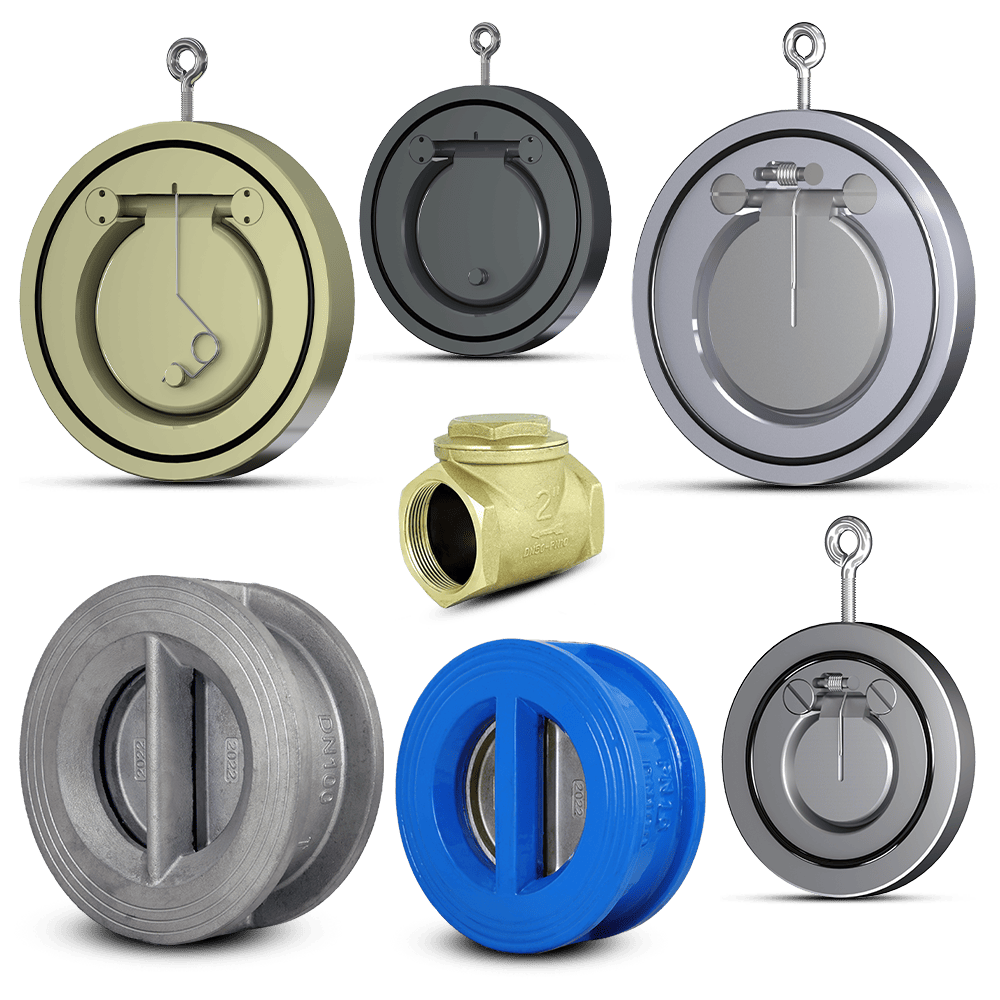
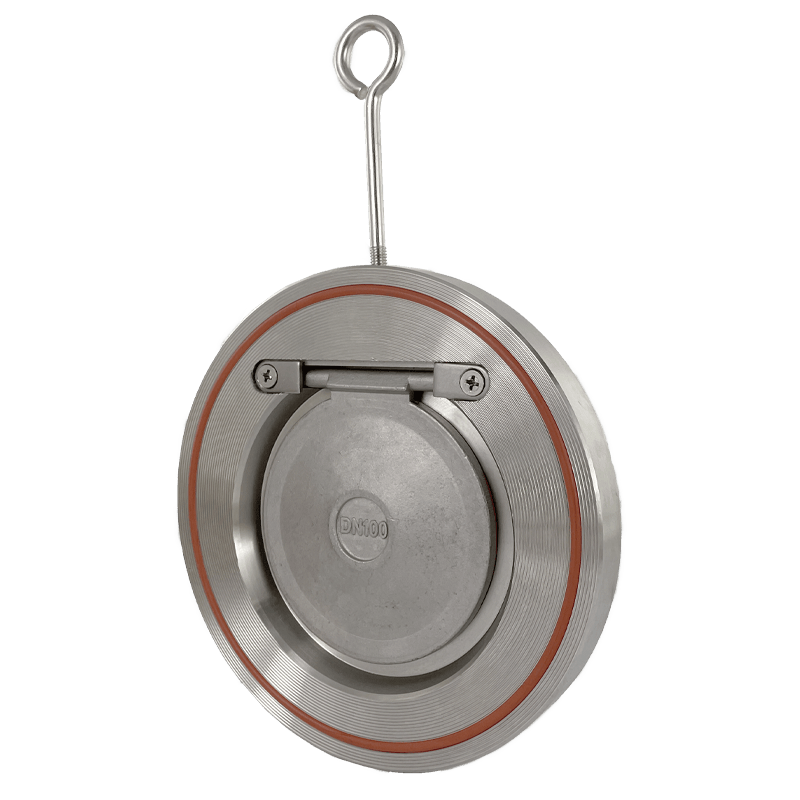
01 Wafer Check Valves (RK100, RK101, RK106)

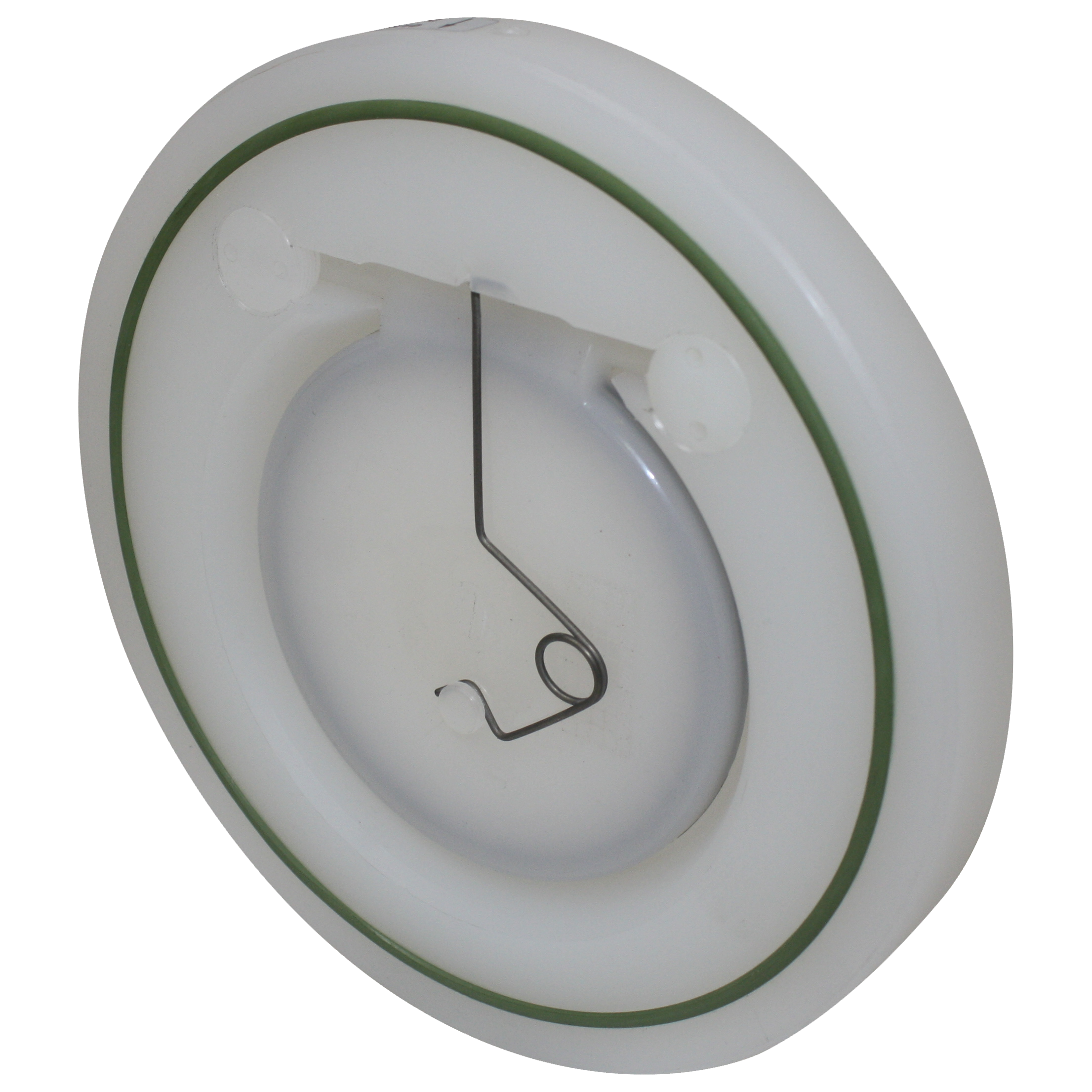
The wafer check valves clamp between two counter-flanges, so they need no flanges of their own. A single hinged flap swings clear on forward flow. The RK100 comes in stainless steel 1.4408 or galvanised steel 1.0619, the RK101 pairs stainless steel with an FKM/Viton seat, and the RK106 uses a PP-H body for chemically aggressive media. Sizes span DN32 to DN300 at up to 16 bar, optionally with spring return.

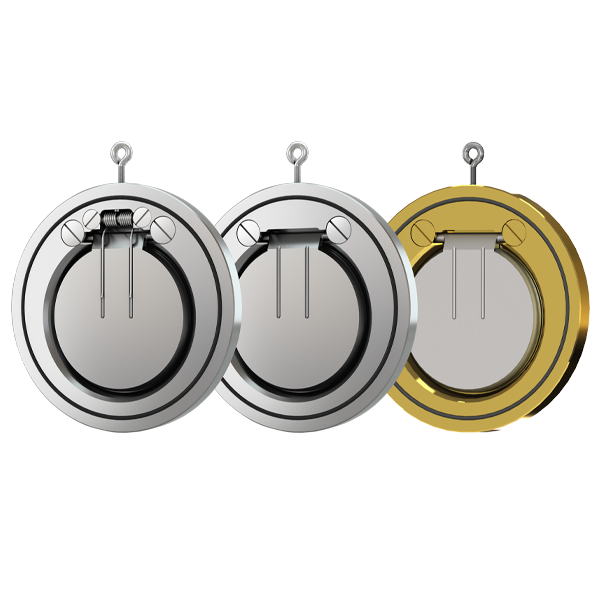
02 Dual Plate Check Valves (RF200, RF202)

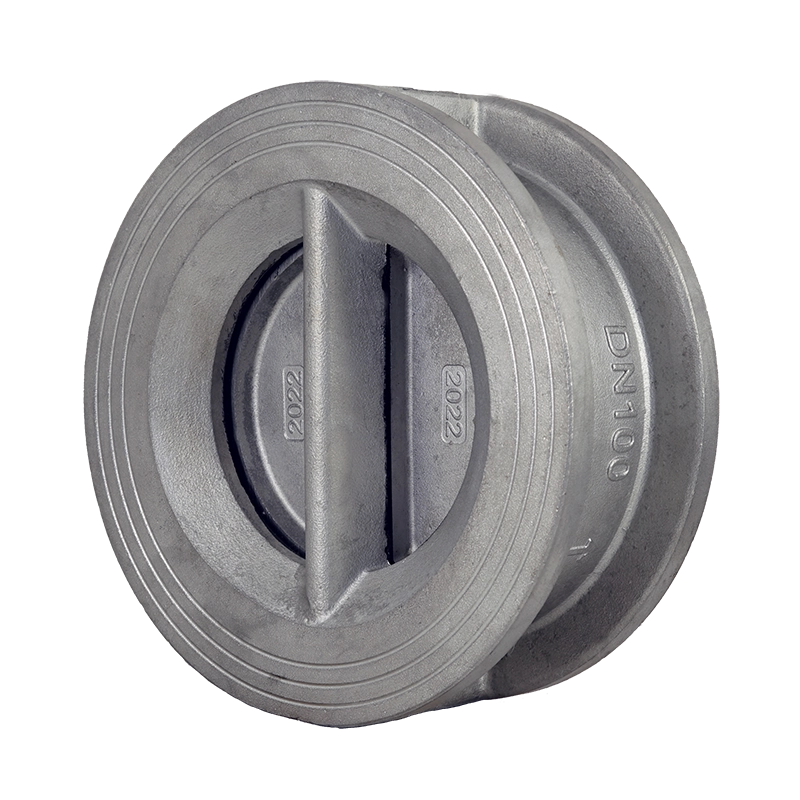
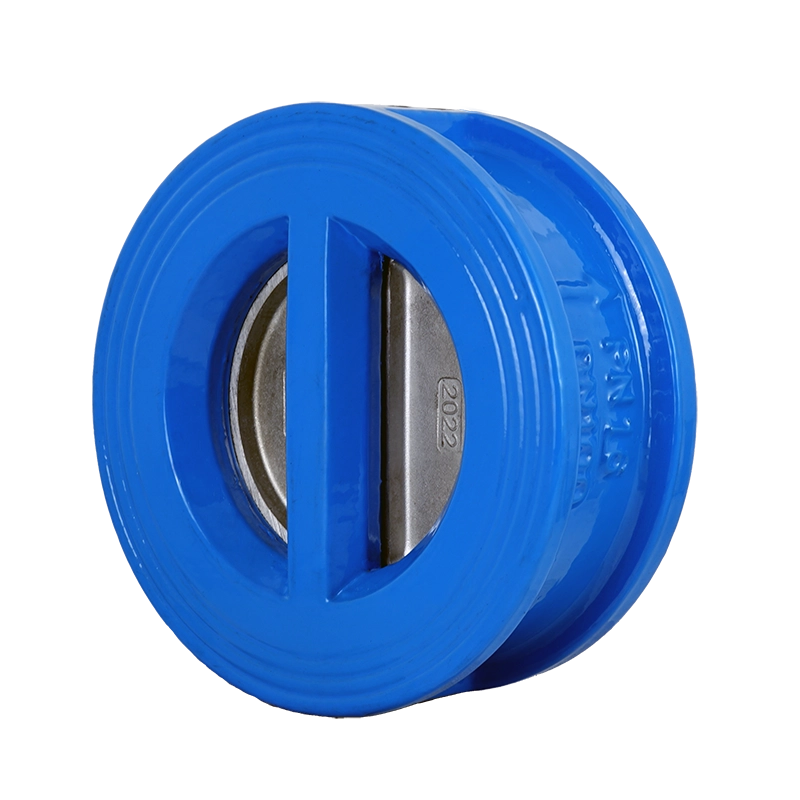
The dual plate check valves carry two spring-loaded half-discs on a central shaft. Each plate travels only half the swing angle, so the valve closes noticeably faster. The RF200 uses a GGG40 body with CF8M plates and an epoxy coating of 150 µm in RAL 5015. The RF202, by contrast, is built entirely from CF8M stainless steel. Both cover DN50 to DN300 at PN10/16 with NBR or EPDM seats.

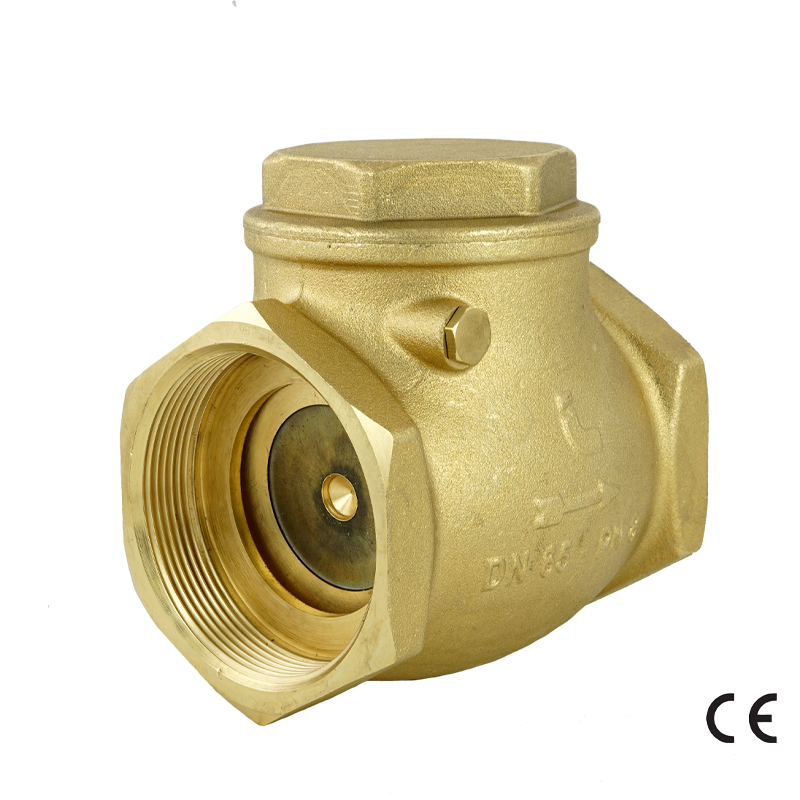
03 Threaded Check Valves (RK104)

The threaded check valves screw straight into the line through a BSP female thread to ISO 228/1. Their brass body keeps the assembly compact and economical. Sizes run from DN10 to DN100 with NBR, EPDM or PTFE seats. This design suits building services, HVAC circuits, laboratory lines and instrumentation connections.

Body Materials

1. Stainless Steel 1.4408 / CF8M (AISI 316)

Application: chemical and pharmaceutical processing, food and beverage plants, seawater, chlorinated water, outdoor installations
Temperature: up to +200 °C with a PTFE seat, up to +300 °C with a metal seat
Advantages: excellent corrosion resistance through molybdenum, hygienic and low-maintenance, no iron contamination of the medium
Limitations: higher material cost; not resistant to hydrofluoric acid

2. Ductile Iron GGG40 with Epoxy Coating 150 µm, RAL 5015

Application: water supply, wastewater, cooling circuits, general utility service; standard body of the RF200 dual plate series
Temperature: up to +120 °C with an EPDM seat · PN10 and PN16
Advantages: robust and economical for larger bores; CF8M plates and SS316 shaft keep all wetted internals corrosion-resistant
Limitations: unsuitable for aggressive chemicals and chloride-rich media

3. Galvanised Steel 1.0619

Application: neutral aqueous media, HVAC, utility and general industrial water service; RK100 wafer bodies
Temperature: up to +120 °C (seat dependent) · PN10 to PN40
Advantages: high strength at moderate cost, zinc layer adds basic corrosion protection
Limitations: not suitable for corrosive media, food contact or high-temperature service

4. Brass (RK104 threaded series)

Application: drinking water, heating circuits, HVAC, laboratory and instrumentation lines at small bores
Temperature: −10 °C to +100 °C
Advantages: excellent machinability for threads, good corrosion resistance in water, compact and economical
Limitations: unsuitable for ammonia, aggressive chemicals and highly chloride-rich water

5. PP-H and PVC-U (RK106 plastic series)

Application: chemical dosing, acids, alkalis, demineralised water, plating lines and process circuits where metal ions are unwanted
Temperature: PP-H up to +80 °C · PVC-U up to +60 °C
Advantages: broad chemical resistance, very low weight, electrically non-conductive, no corrosion
Limitations: lower pressure and temperature limits than metal; not suitable for steam or mechanical shock loads

Seat and Internal Materials

1. NBR (Nitrile Butadiene Rubber)

Application: mineral oils, fuels, hydrocarbons, neutral aqueous media, wastewater, gases and caustic solutions
Temperature: −10 °C to +80 °C
Advantages: outstanding oil and grease resistance, good mechanical strength, economical
Limitations: not suitable for hot water above 80 °C, steam or oxidising chemicals

2. EPDM (Ethylene Propylene Diene Monomer)

Application: drinking water, hot water circuits, steam, dilute acids and alkalis, water treatment, food processing
Temperature: −40 °C to +120 °C
Advantages: excellent ozone and ageing resistance, wide temperature window, standard seat for water service
Limitations: not compatible with mineral oils, hydrocarbons or petroleum products

3. FKM / FPM (Viton)

Application: fuels, mineral oils, aromatic and halogenated hydrocarbons, concentrated acids, chemical dosing, oil and gas
Temperature: −10 °C to +180 °C
Advantages: more chemically resistant than NBR at elevated temperatures, ozone-resistant, long service life
Limitations: unsuitable for ketones, esters, hot water and steam

4. PTFE (Polytetrafluoroethylene)

Application: aggressive acids, alkalis, solvents and oxidising agents; the choice where NBR and EPDM fail
Temperature: −10 °C to +200 °C
Advantages: near-universal chemical resistance, very low friction, FDA-compliant for food and pharmaceutical duty
Limitations: lower elastic recovery than elastomers, so a return spring is required for reliable sealing

5. Metal Seat

Application: steam, thermal oil, abrasive media, coarse particles and any service beyond elastomer limits
Temperature: −10 °C to +300 °C
Advantages: maximum durability, no ageing of the sealing element, bi-directional metal sealing available
Limitations: lower leak-tightness than soft seats; a return spring is always required

6. Flap, Shaft, Spring and Fasteners

Application: internal components across all RK and RF series
Materials: flap in stainless steel 1.4408 / 1.4581 · return spring in 1.4571 · screws in 1.4401 · dual plate shaft and spring in SS316
Advantages: corrosion-resistant internals even where the body is cast iron or galvanised steel; the spring makes closure position-independent
Limitations: a spring return raises the cracking pressure slightly, so the opening differential increases

Fergo check valves comply with the Pressure Equipment Directive 2014/68/EU and carry the CE mark. Wafer bodies fit flanges to DIN EN 1092-1 form B as well as DIN 2632 and DIN 2633. Dual plate face-to-face lengths follow EN 558-1 series 16, and threaded connections meet ISO 228/1. For inch-based pipework, Fergo supplies versions to ASME B16.5 Class 150 and Class 300 as well as ANSI Class 125.

Inspection documents to EN 10204 — type 2.2 works certificate or type 3.1 inspection certificate — are available on request. A full overview of all certificates is published on the Fergo certificate page. For highly aggressive media, PFA-lined check valves extend the range further. You can verify seat compatibility with your medium beforehand using the Fergo resistance check.

Fergo holds more than 25,000 industrial valves in stock. Over 490 of them are check valves across the RK100, RK101, RK104, RK106, RF200 and RF202 series — in every common size, body material and seat. Orders are picked the same working day, so most stock items reach you within two to five working days.

Fergo ships across Europe — including the United Kingdom, the Nordic countries and all other EU member states. Smaller threaded valves travel by parcel service, whereas large-bore and consolidated shipments go by forwarding agent. You will find shipping costs, payment options and express terms on the shipping and payment terms page. For special alloys, non-standard sizes or 3.1 material certificates, please contact us through the customised solutions section.